
What Is an Autonomous Marketing System? A Plain-English Guide for Local Operators
By The Amagna Crew
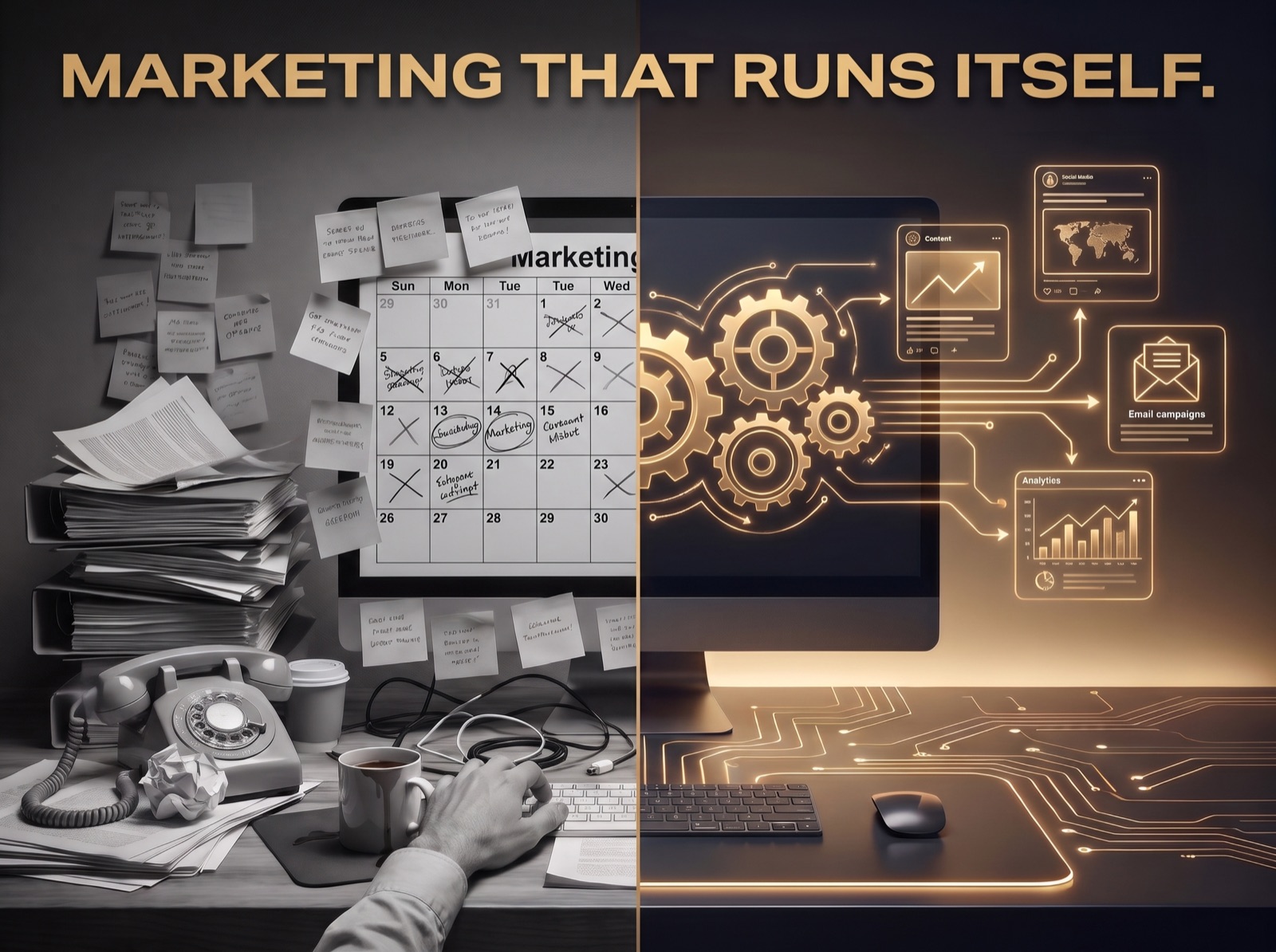
An autonomous marketing system is a connected set of AI agents that runs the repetitive work of marketing on its own — creating content, running ads, following up with leads, and reporting on results — while a human stays in control of strategy, budget, and anything that reaches a real customer. It runs daily, without being reminded.
If you run a local business, you've probably been sold "marketing" a dozen times. A logo. A batch of posts. An ad campaign that ran hot for a month, then went quiet when the person managing it moved on to a bigger account.
An autonomous marketing system is a different animal. It isn't a service you buy once and hope sticks. It's a machine that runs your marketing day after day, with a human watching the wheel. You stay in control of the big decisions. The system does the daily grind.
Why does "autonomous" matter?
Because most marketing doesn't fail from bad ideas. It fails because nobody keeps doing it.
The pattern is always the same. You get a good month. The phone rings, the crew is stretched, you're on a roof or in an exam room. The posting stops. The follow-up texts never go out. The ad budget keeps drawing down with nobody watching it. Then the pipeline is dry and you start over from zero.
Consistency is the whole game, and humans are bad at consistency when they're also running a business. That's not a character flaw. Marketing is the only job in your company with no customer waiting on the other end of it, so it's the first thing that slips.
Autonomy fixes exactly that failure mode. A system doesn't get tired, doesn't forget to post, doesn't leave a lead sitting for three days because Thursday got away from it. It does the same reliable work every single day — which happens to be the work that compounds into more calls, more booked jobs, and steadier revenue.
The unglamorous truth is that marketing that works for local operators is mostly boring and repetitive. Show up where people are looking. Answer fast. Stay in front of people who already know you. Those are machine jobs.
How is it different from an agency or marketing software?
An agency sells you people's time. Software sells you a tool you still have to operate. An autonomous marketing system sells you the output — the work itself, done on a schedule, with you approving what matters.
That difference shows up hardest when you get busy, which is the exact moment your marketing normally dies.
| | Traditional agency | Marketing software | Autonomous marketing system | |---|---|---|---| | Who does the work | A team you don't manage, often junior, often shared across many accounts | You, or someone on your staff | AI agents doing the execution, with a human reviewing | | What happens when you get busy | Work slows to whatever the retainer covers; you chase them for updates | Nothing happens — the tool waits for a human to log in | It keeps running on its own schedule | | Cost structure | Monthly retainer that scales with headcount and hours | Per-seat or per-contact fees that grow as you grow | Priced to the system, not to hours worked | | Speed to change something | Email, meeting, revision round, wait | Fast, if you know the tool | Same day, because the system already knows your brand | | Institutional memory | Lives in an account manager who may leave | Lives in whoever set it up | Lives in a shared memory layer that persists | | Who stays in control | The agency decides, you approve invoices | You, entirely — which is the problem | You: strategy, budget, and final say on anything customer-facing |
None of this makes agencies useless. Plenty of businesses need brand work, a real campaign concept, a photographer. But if what you need is for the marketing to happen, week after week, an hourly-billed team is an expensive way to buy consistency.
What does an autonomous marketing system actually do?
Five jobs. Each one maps to a place where local businesses lose money.
- Content. Fresh posts, short videos, and emails every week, written in your voice — without you sitting down to write a word. The system pulls from what you actually do: the jobs you completed, the questions customers ask, the objections you hear on every call. That's the difference between content that sounds like a local operator and content that sounds like a stock photo.
- Ads. Paid campaigns on Meta, TikTok, and Google, tuned continuously so the right local people see you. The tuning is the part owners underestimate. An ad account left alone drifts — audiences fatigue, costs creep, one creative eats the budget while a better one sits paused. That's tedious daily work with real money attached, which is precisely why it should be automated and reviewed rather than checked when someone remembers.
- A memory layer. One brain that holds your brand, your services, your service area, your pricing posture, your customers, and what's already working. This is the piece that makes the rest cohere. Without it you get disconnected tools repeating themselves, contradicting each other, and emailing a customer an offer they already took. With it, every agent works from the same file on your business — and that file gets richer the longer it runs.
- Automations. Follow-ups, booking confirmations, review requests, reminders, and the small administrative busywork that sits between an interested person and a paying customer. Most local businesses don't have a lead problem, they have a follow-up problem — the lead came in, nobody called back within the hour, and it went to whoever did. We wrote about that specific leak in more booked jobs without chasing leads, and it's the same reason staying top of mind matters so much in referral-driven trades.
- Search visibility. Showing up when local customers look for what you do — in Google's map results, on your website, and increasingly inside AI assistants when someone asks ChatGPT who to hire. Those are related but not identical jobs. Your Google Business Profile is usually the cheapest lead source you own, and getting cited by AI tools follows different rules than classic SEO — we break that down in AEO vs SEO.
Run all five together and they reinforce each other. Content feeds search. Search feeds ads better audiences. Automations catch what all three produce. The memory layer keeps them from working at cross purposes.
"Autonomous" doesn't mean "unsupervised"
This is the part that matters most, and the part most AI marketing pitches skate past.
A good system always keeps a human in the loop for anything that reaches a real person or a real budget. The AI drafts; you approve. The AI flags; you decide. You get the leverage of a full marketing team without handing over the keys to a black box.
Think of it like a ship's crew. Each specialist has one job — one runs the ads, one makes the content, one keeps leads warm, one builds the automations. A captain coordinates them. And you're the owner at the helm, setting the course. The crew sails; you decide where.
The metaphor holds in the uncomfortable direction too. A crew doesn't relieve the owner of responsibility for the voyage. If you never look at the chart, you can still end up somewhere you didn't want to go — efficiently. Autonomy buys back your hours, not your judgment.
Practically, a handful of things stay with you: what you sell and for how much, which markets you want, what you'll never say about a competitor, and the final read on anything customer-facing before it ships. Everything upstream of those decisions is fair game for automation.
What an autonomous marketing system is not
It is not a magic revenue button, and it's worth being blunt about the limits before you buy anything.
It won't fix a broken offer. If your pricing is off or customers don't come back, marketing just distributes that faster. A system that generates more calls for a business that can't convert them makes the problem louder, not smaller.
It won't replace your judgment about your market. You know why the shop across town wins certain jobs, and which neighborhoods pay on time. That knowledge has to be fed in — it isn't inferred.
It won't answer the phone like you would. Automation can qualify, schedule, and follow up. It cannot walk a nervous homeowner through a decision that costs more than their last car, or read a room in a listing appointment. Every business we work with still needs a human at the point of trust.
It won't produce results the first week. Ads can move fast. Search visibility, reviews, and referral compounding do not. Anyone promising otherwise is selling something.
It won't run itself with zero input from you. The system needs a course. That's a short working session up front and a light review rhythm after — not a second full-time job, but not nothing either.
And it isn't right for everyone. If you have no capacity to take on more work, or your brand genuinely needs rebuilding from scratch, do that first.
Who is it actually for?
Operators who are good at the work and short on time — home services, real estate, medical and dental practices, ecommerce brands, and multi-location businesses trying to keep several markets consistent at once.
The clearest signal: if your revenue swings month to month because marketing is the first thing that slips when you get busy, you're the case this is built for. The second is that you've been burned by an agency before and are tired of paying for meetings.
Multi-location operators tend to get the most out of it, because the same work has to happen many times over and manual consistency across locations is close to impossible. You can see the industries we work in on who we serve, and if your setup doesn't fit a standard build, we handle those as custom systems.
How do you know it's working?
You watch a small number of real numbers, not a dashboard full of vanity metrics.
For most local operators the honest scoreboard is: how many qualified inquiries came in, how many turned into booked work, what it cost to get them, and how fast you responded. Impressions and follower counts are context at best. If leads are up and cost per booked job is flat or falling, the system is working.
The other test is subtler: does marketing still require you to remember it? If the answer is no, and the pipeline held through your busiest stretch, that's the actual deliverable.
Frequently Asked Questions
Is an autonomous marketing system just marketing automation with a new name?
No. Traditional automation executes rules you wrote — if a form is submitted, send this email. An autonomous system decides what work needs doing, produces it, and adapts as results come in. Automation is a set of instructions. An autonomous system is a set of agents with shared memory of your business, a defined job, and a human approving anything that touches a customer or a budget.
Do I lose control of my brand voice?
No, and this is where the memory layer earns its keep. The system holds how you talk, what you sell, what you refuse to claim, and the phrases you actually use with customers. Drafts come to you before anything goes out. In practice, owners find their voice gets more consistent, not less, because it's written down in one place instead of living in whoever happened to be posting that week.
How much of my time does it take?
Most of the effort is front-loaded: a working session to get your business into the system properly, then a light review rhythm — approving content, reading a short performance summary, answering questions the system flags. It's less time than managing an agency, because you're reviewing finished work rather than sitting in status calls describing what you want.
What if I already have a marketing person?
They usually get better at their job. An autonomous system removes the production grind — drafting, scheduling, tuning, chasing follow-ups — and leaves them the parts that need a human: relationships, offers, partnerships, judgment calls. The failure case isn't a person plus a system. It's a person doing machine work while strategy goes untouched.
How is this priced compared to an agency?
Agencies price to hours and headcount, which means more work costs more people. A system prices to the system itself, so output isn't capped by someone's calendar. The clearest comparison is what you're currently spending against how much actually ships each month. Our pricing is public for exactly that reason.
The bottom line
An autonomous marketing system turns marketing from a thing you keep meaning to do into a thing that just happens. You get the output of a marketing team, the consistency of software, and the control of staying the final word on everything that matters.
That's the whole idea behind what we build at Amagna — the machine, plus the content that fuels it.
To see what it would look like for your business, chart your own Gold Map: a free, AI-built plan for exactly how we'd grow your business.
Want this for your business?
The Gold Map builds you a specific, step-by-step plan — free.
Get your Gold Map