
How Home Service Businesses Get More Booked Jobs Without Chasing Leads
By The Amagna Crew
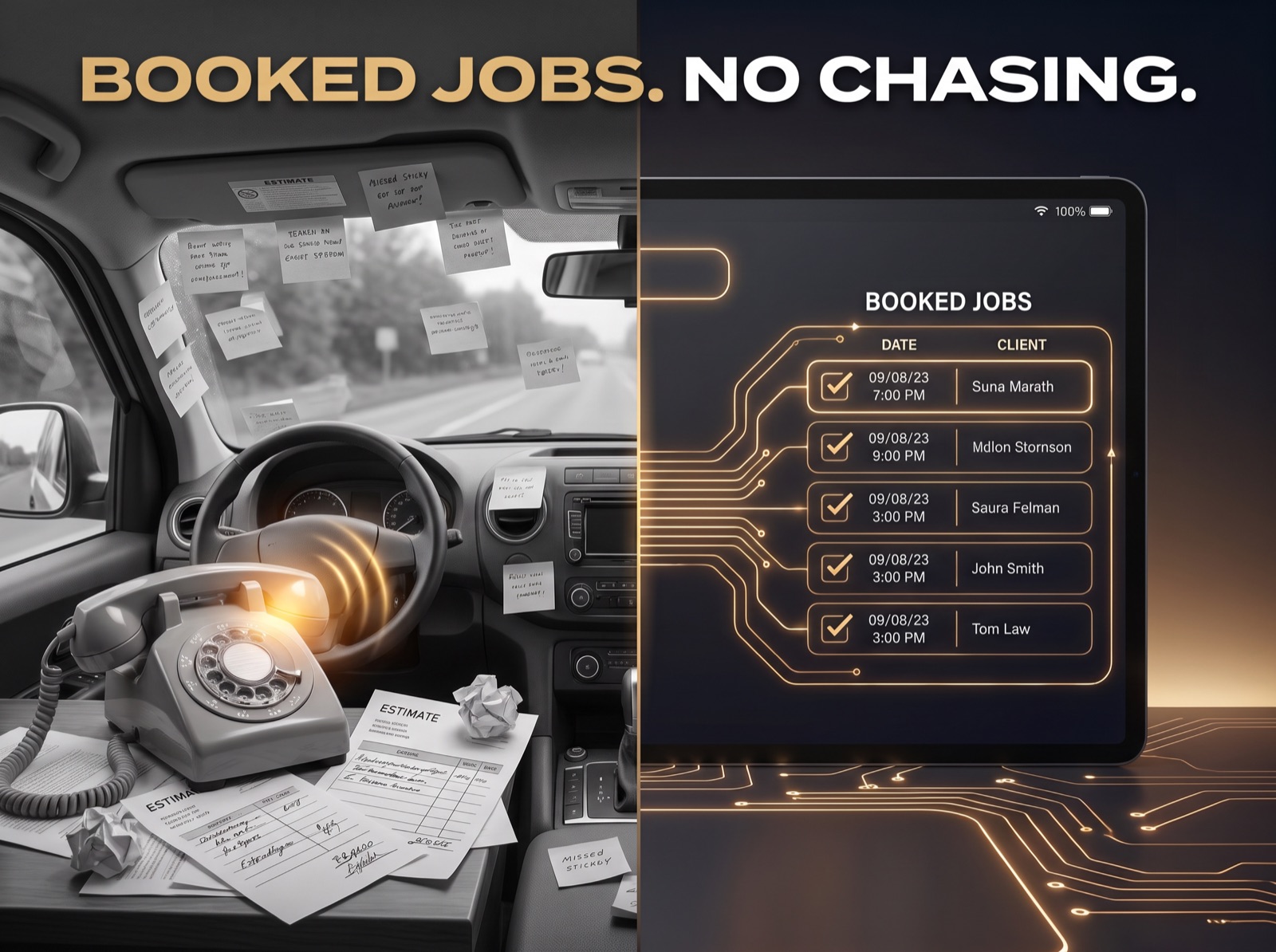
Most home service businesses get more booked jobs by answering the leads they already have, faster. The lead came in while the crew was on a roof. Nobody called back within the hour. It went to whoever did. Fix the follow-up gap first, then worry about volume.
Ask most home service owners what they need and they'll say "more leads." But when we actually look under the hood, the lead count usually isn't the problem. The problem is what happens after a lead comes in — and what doesn't happen on the slow weeks when nobody's marketing.
If your calendar swings from slammed to silent, this one's for you.
Do I have a lead problem or a follow-up problem?
You have a follow-up problem if leads are arriving and you can't say, off the top of your head, what happened to each one. That's the test. Not how many came in — what happened next.
Here's the honest version. A form fill lands mid-morning. You're in a crawlspace. You see it after lunch. You call at the end of the day, get voicemail, leave a message, and move on. Days later you notice the lead again and think, I should follow up on that. You don't.
Meanwhile that homeowner texted two other companies. One of them replied within minutes with a name and a question about the job. They're on the schedule now.
Nothing about that story is a marketing failure. Your ads worked. Your Google Business Profile worked. Your reputation worked. The lead showed up. It just showed up while you were busy being good at your actual job.
Buying more leads on top of a broken follow-up process just makes you pay twice for the same problem. Plugging the hole is cheaper and faster.
The real reason the phone goes quiet
Home service revenue rides the season and the referral. A good month of word-of-mouth feels great — until the referrals dry up and there's nothing in the pipeline behind them. You were too busy doing the work to do any marketing, so when the work slows down, there's nothing queued to replace it.
That's not a lead problem. That's a consistency problem. And you can't fix consistency by working harder — you're already maxed out. You fix it with a system that keeps marketing even when you're on a roof or under a sink.
The two problems compound. Slow stretches are when you finally have time to follow up — but by then the leads are cold. Busy stretches generate the most leads and the worst response times. The busier you are, the more you leak, and hustle doesn't get you out of it.
Three things that fill a calendar
You don't need a hundred tactics. You need three things done reliably.
1. Show up where local customers look. That means a Google Business Profile that's actually maintained — real photos, real reviews, the right categories — plus steady posts so you're the name people see when they search "[your service] near me." Most of your competitors set this up once and never touch it again. Staying active is the edge.
2. Respond in minutes, not days. Here's a number worth tattooing on the wall: leads contacted within 5 minutes are vastly more likely to book than leads contacted an hour later. When you're on a job, that 5 minutes is impossible by hand — so the response has to be automated. Every inbound lead gets an instant text, a follow-up the next day, and a nudge a few days later. That alone recovers jobs you're currently losing to silence.
3. Turn finished jobs into more jobs. Every job site is content. A 20-second before/after clip of a clean driveway or a new install does double duty: it feeds your social feed and becomes an ad. And every happy customer is a review request away from boosting your local ranking. Most owners never ask. The ones who ask consistently win.
None of the three requires you to be clever. They require you to be present — exactly the kind of work a machine handles better than a person with a truck and a schedule.
How fast do I actually need to call a lead back?
Fast enough that you're the first company they hear from. In practice that means minutes, not hours — and since you can't guarantee minutes by hand, the first touch has to happen without you.
The thing homeowners are buying at that moment isn't your workmanship. They can't evaluate your workmanship. They're buying relief from uncertainty. Water is coming through a ceiling, or the AC is dead, or a storm took shingles off, and they want someone to say I've got you, here's what happens next. The first company that says it usually wins, even if a slower competitor would have done better work for less.
That's uncomfortable, and it's also good news — being first is a systems problem, and systems problems are solvable.
| | Chasing leads by hand | A system that answers for you | |---|---|---| | First response | Whenever you get off the job | Within seconds, every time | | Nights and weekends | Missed or delayed | Handled the same as any other hour | | Second and third follow-up | Depends on memory | Runs on a set sequence | | Who does the work | You, after hours | The system, with you approving what matters | | What happens when you get busy | Response time gets worse | Response time stays the same | | Where leads end up | Notebook, inbox, texts, voicemail | One place, with status on each | | Cost of a slow week | Nothing queued behind it | Content and follow-up keep running |
The right-hand column isn't more effort. It's a different kind of effort — built once instead of performed daily.
How does automated follow-up actually work?
It works as a chain of small, boring steps that fire whether or not anyone remembers them. Here's the shape of it for a typical home services operator:
- Every lead lands in one place. Form fills, calls, Google Business Profile messages, ad leads, and texts all route into a single inbox instead of four. Nothing lives only in your phone.
- An instant text goes out. Within seconds of the lead arriving: a real reply using their name and the service they asked about, letting them know you got it and when you'll call. This is the touch that beats your competitors.
- The lead gets qualified. A couple of simple questions — service type, address area, urgency — so that when you do call, you already know what you're walking into and whether it's a job you want.
- You get pinged with the context. Not a raw notification. The lead, the answers, and the suggested next step, so you can call back between jobs without reading a thread.
- Booking happens without phone tag. Where it makes sense, the homeowner picks a window themselves from your real availability instead of trading voicemails with you.
- Unanswered leads get chased automatically. A next-day follow-up, then a nudge a few days later, then a final check-in. Polite, short, and stopped the moment they reply or book.
- Finished jobs turn into review requests. The job closes, and a one-tap review link goes out while the work is fresh — the same mechanic behind turning customers into reviews automatically.
- The old list gets touched. Past customers and dead leads get periodic, useful contact so your database keeps producing work instead of sitting there.
Each step is small. The compounding is the point, and it's the core idea behind an autonomous marketing system.
Why automation beats hustle here
You could do all three by hand. You won't — not because you're lazy, but because you have a business to run. The owners who win aren't the ones with the most willpower. They're the ones who set up a system so the work happens whether they remember it or not.
That's the whole point of an autonomous marketing system: the content gets made, the leads get answered, the reviews get requested, and the ads keep running — around the clock, without you babysitting it. You stay the final say on anything that matters. The machine handles the rest.
Most agencies sell the top of the funnel because it's easier to bill for. More impressions, more clicks, more leads. But if the bucket leaks, a bigger hose just makes a bigger mess. That's why our home services work starts with response and follow-up before it touches ad spend.
What a follow-up system will not fix
It won't fix pricing, and it won't fix a crew problem.
If you're quoting well above what your market pays and can't articulate why, faster replies just get you to the "no" quicker. If your techs show up late, leave a mess, or don't explain the work, automation will simply deliver more people to a bad experience — and then dutifully ask them all for reviews.
It also won't fix an empty top of funnel. If almost nothing is coming in, there's nothing to follow up with, and you need visibility work first — profile, local presence, some paid reach. Follow-up multiplies what exists; it doesn't create it.
And it won't make you money on jobs you shouldn't take. A system that books everyone books your worst customers too. Qualification questions help, but you still have to be willing to say no.
Last one: it isn't instant. Reviews accumulate, local rankings move gradually, and a database that's been ignored takes a few cycles to warm back up. Anyone promising otherwise is selling something. We publish our pricing plainly for the same reason.
What should I fix first?
Lock down your Google Business Profile and text every past customer a one-tap review link. That single move tends to lift inbound calls before you spend a dollar on ads.
Then fix the first touch. Pick one channel — usually your website form — and make sure something goes out automatically within seconds. Not a perfect sequence. One message.
Only then look at spending more on traffic. Turning up volume before those two are handled is how owners end up convinced marketing doesn't work, when what actually happened is that it worked and nobody was there to answer.
Frequently Asked Questions
Isn't an automated text impersonal?
Less impersonal than silence. Homeowners aren't comparing your text to a warm handshake — they're comparing it to the three companies that never replied. A good automated first touch uses their name, references the service they asked about, and tells them when a human will call. It buys you the hour you need to get off the roof and call them properly.
Will this work if most of my jobs come from referrals?
Yes, and referrals usually get better. Referred leads still go cold when nobody answers, and referral sources still need reminding that you exist. A system that responds instantly and keeps in touch with past customers protects the word-of-mouth you already earned, instead of leaving it to memory. It also gives you something in the pipeline for the stretches when referrals go quiet.
Do I lose control of how customers are treated?
No. You approve the message templates, the follow-up cadence, and anything that touches pricing or scheduling rules. The system handles the repetitive part — the instant reply, the reminder, the review request — and hands the actual conversation to you. Any lead can be pulled out of an automated sequence the moment a human picks it up.
How is this different from a CRM I already pay for?
Most CRMs are filing cabinets. They store the lead and wait for you to act. The difference here is that the actions run on their own: the reply goes out, the follow-up fires, the review request sends. If your current tool does that and you've configured it, you're most of the way there. If it's mostly a place where old leads go to die, it isn't doing this job.
Does this only work for HVAC and plumbing?
It works for any trade where a homeowner has an urgent problem and calls more than one company — HVAC, plumbing, roofing, electrical, pressure washing, remodeling, landscaping. The speed advantage is strongest on emergency work and still meaningful on planned projects, where the follow-up sequence matters more than the first sixty seconds. You can see the full list of trades on who we serve.
If you want the whole machine built for you — the content, the follow-up, the ads, the reviews — that's what we do at Amagna. Chart your free Gold Map and we'll hand you a step-by-step plan for filling your calendar, built specifically for your business.
Want this for your business?
The Gold Map builds you a specific, step-by-step plan — free.
Get your Gold Map