
Turn Happy Patients Into Reviews — Automatically and Compliantly
By The Amagna Crew
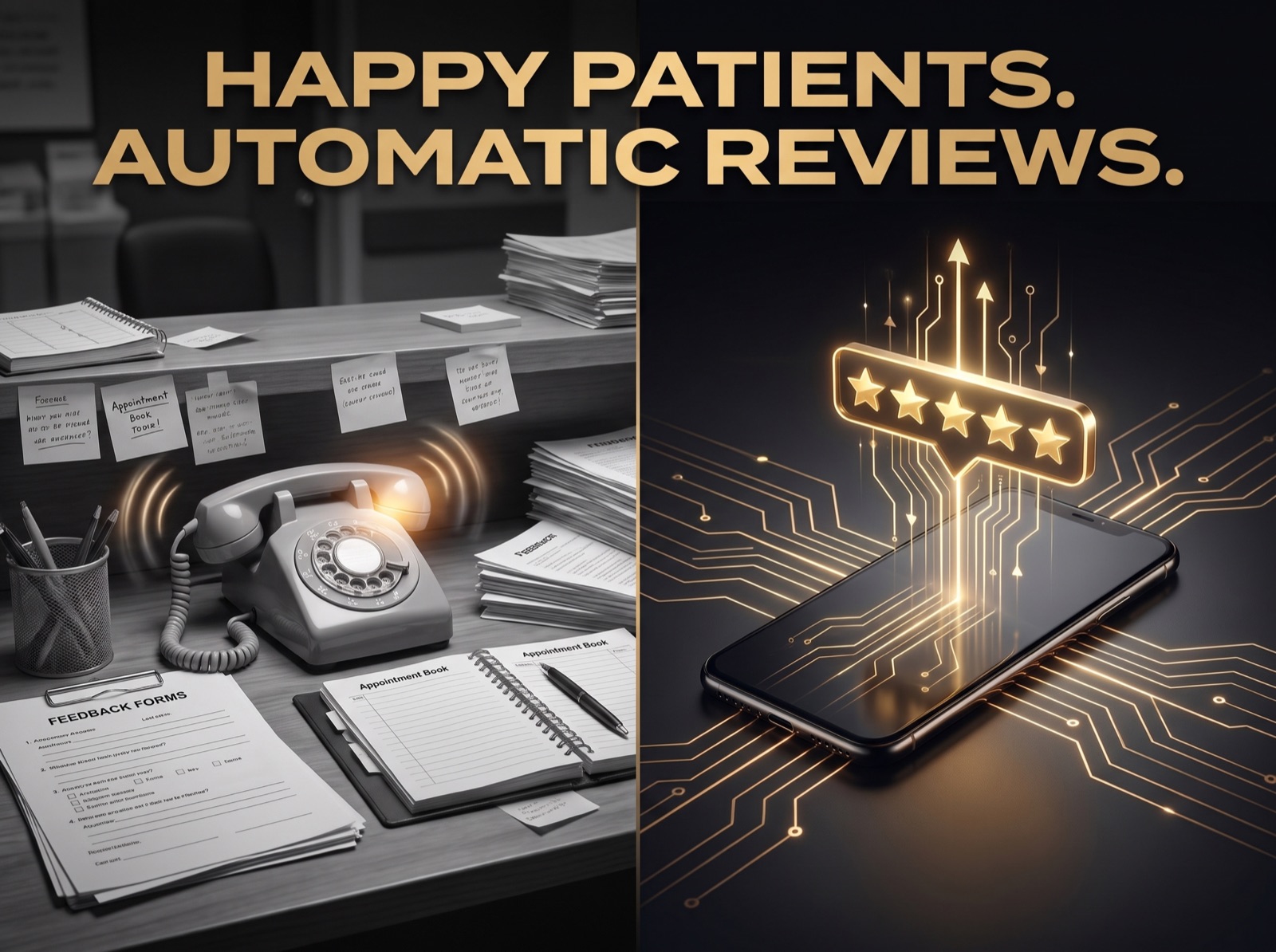
Automated patient review generation is a system that asks every satisfied patient for an honest review right after their visit — by text or email, with a one-tap link — instead of depending on staff to remember. Templates stay human-approved, and your public rating starts tracking the care you actually deliver.
Here's a quiet unfairness most practices live with: your happiest patients almost never leave a review, and the one frustrated person does. So your rating online drifts lower than the care you deliver — and new patients, who read those reviews before they ever call, judge you by it.
Reviews aren't vanity. For a local practice they're one of the biggest factors in whether a searching patient picks you, and a real signal to Google and AI assistants deciding who to recommend. The gap between your real reputation and your online one is fixable, and it's fixable on autopilot.
Why do great practices have mediocre review profiles?
It's not the care. It's the ask. A delighted patient walks out, life resumes, and they never think to post. Meanwhile the team is too busy running the office to ask every patient, every day, at the right moment. So the only people motivated enough to post unprompted are the occasional unhappy ones.
The entire problem is timing and consistency — exactly the kind of thing humans are bad at maintaining and systems are good at.
From the patient's side it makes sense. Leaving a review is a small favor with no payoff. Complaining has a payoff: it discharges frustration. That asymmetry is baked in, and you don't beat it with goodwill. You beat it by lowering the effort on the happy side until asking takes one text and reviewing takes one tap.
The second reason is structural. Most offices that do ask, ask inconsistently — a front desk lead gets fired up, asks everyone for a couple of weeks, then a schedule crunch hits and the habit dies. You end up with a cluster of reviews and a gap on either side. Patients and search engines read that gap the same way.
What does an automated review system actually do?
The goal is simple: ask the right patient, at the right moment, every time, in a way that's easy to act on.
- Well-timed requests. A gentle, automated nudge goes out shortly after a good visit — when satisfaction is highest — by text or email, with a one-tap link to the right place.
- Steady velocity. Instead of a frozen pile of old reviews, you get a consistent trickle of fresh ones, which matters more for ranking and trust than a single number.
- The right routing. Patients are pointed to where it helps most, and any private concern has a path to reach the office directly so it can be handled like a relationship, not a public fight.
- No fabrication, ever. A real system only ever asks real patients for honest feedback. There are no fake reviews, no incentives that cross a line — just the asks you should have been making all along.
Underneath it's the same idea we describe in what an autonomous marketing system is: take a task that only works when it happens every time, and hand the repetition to software while a person keeps judgment and tone.
Manual review chasing vs. an automated system
Most practices aren't choosing between automation and nothing. They're choosing between automation and a manual habit that keeps collapsing.
| | Manual asking | Automated system | |---|---|---| | Who remembers to ask | Whoever's at the desk, if it's not slammed | Runs after every eligible visit | | Timing | Whenever it comes up, sometimes days later | Shortly after the visit, while it's fresh | | Coverage | Patients your team happens to click with | Every patient who fits your rules | | Effort per ask | A conversation, a card, a follow-up | One tap for the patient, none for staff | | Consistency | Spikes and long gaps | Steady trickle | | Negative feedback | Usually discovered publicly | Routed to the office first, privately | | Reporting | Gut feel | Requests sent, reviews landed, response times | | Staff burden | Real, and grows with volume | Setup, then periodic template review |
The row that matters most is negative feedback. Without a system you learn about an unhappy patient at the same moment the public does. With one, you usually hear it first, while it's still a conversation.
How does an automated review system work, step by step?
It attaches a request to a completed visit and then gets out of the way. Nothing exotic happens — the value is entirely in the fact that it happens every time.
- Pick the trigger. Usually a completed appointment in your practice management or scheduling software. You decide which visit types count.
- Set the exclusions. Some patients shouldn't be asked — sensitive visits, billing disputes, anyone who opted out, anyone asked already. Written down once, enforced automatically after that.
- Approve the wording. Your team writes the text and email templates in your own voice and signs off. Nothing patient-facing goes out that a human hasn't read.
- Send the ask. A short message after the visit thanking the patient and asking how it went, with one tap to continue.
- Route by sentiment. Happy patients land on your review page in the fewest possible steps. Patients with a concern land on a private form that reaches the office, not the public internet.
- Follow up once, gently. One reminder to people who didn't respond, then silence. The system stops asking rather than nagging.
- Surface the responses. New reviews go to whoever owns replies, so you can thank people and address concerns without living in a dashboard.
- Check the numbers monthly. Requests sent, reviews landed, average rating, response time. If something slips, adjust the timing or the wording — not the whole approach.
Step five is where practices most often go wrong on their own. Giving unhappy patients a private path first isn't hiding anything — it's the instinct that makes you pull someone into an office instead of debating them in the waiting room.
How do reviews affect whether patients find you at all?
Twice over: reviews influence whether you show up in local results, and whether anyone clicks once you do. A profile with recent, plentiful, well-answered reviews outperforms one with the same star rating and nothing new on it.
So reviews and your Google Business Profile are one project, not two. We cover the profile side in why your Google Business Profile is the cheapest lead source you have — the profile is the storefront, reviews are the foot traffic proving it's open. AI assistants answering "who's a good dentist near me" read the same public signals, and a thin, stale profile is easy to skip.
Reviews also compound with everything else. Every ad and referral sends someone to look you up before they call. If the rest of your marketing works and reviews are weak, you're paying to send people to a page that talks them out of it — the same trap we describe in filling a medical practice schedule without the headache.
What do you do about a negative review?
Answer it publicly and calmly, without discussing any specifics of the person's care. That last part is the constraint people forget. You can acknowledge, apologize for the experience, and invite a direct conversation — you cannot confirm someone was a patient or reference their visit.
A short, human reply does more work than most owners expect. The person reading it isn't the reviewer; it's the next prospective patient, scanning for how you handle a bad day. A defensive response confirms their fear. A steady one usually neutralizes the review.
The other half of the answer is volume. One rough review alone at the top of a thin profile is a headline. The same review inside a steady flow of recent positive ones is context. You don't erase criticism — you surround it with the truth.
Keeping it compliant
In healthcare, even review requests have to be handled carefully — no protected information in the wrong channel, nothing patient-facing without sign-off. A system built for practices keeps a human approving the templates and the flow, and keeps the mechanics clean. Automated doesn't mean unsupervised; it means the right ask happens every time, within the lines.
In practice: keep the message generic enough that it reveals nothing about why the person was seen, honor opt-outs immediately, never tie a reward to a positive review, and keep a record of what was sent to whom. Your compliance lead reads every template before it goes live and any time it changes.
None of that is a reason to skip automation. It's an argument for automating with a partner who has built this for medical offices rather than bolting a generic e-commerce review tool onto a practice.
That's the difference between hoping for reviews and having a reputation engine: one depends on someone remembering, the other just runs.
Where should a practice start?
Pick the single moment in your visit when patients are happiest, and start asking — even manually — for a review right then, with a one-tap link. You'll feel the difference in a few weeks.
Do that manually first even if you plan to automate. You'll learn which visit types produce the warmest patients and what wording sounds natural from your team, so you end up automating something you know works.
Frequently Asked Questions
Is it legal to ask patients for reviews?
Yes. Asking a patient for an honest review is fine. What isn't fine is rewarding someone for a positive review, writing reviews on patients' behalf, or including anything about their treatment in the request. Keep the ask generic and optional, honor opt-outs, and have your compliance lead approve the wording before anything goes out.
Should we ask by text or email?
Text generally gets read and acted on faster, which matters when the point is catching people while the visit is fresh. Email gives you more room and suits patients who prefer it. Most practices run both: a short text as the primary ask, email as the fallback for anyone without a mobile number on file or who has opted out of messaging.
How many reviews do we actually need?
Enough that a steady stream is visible, which is a different goal than a target number. A profile with reviews arriving regularly reads as an active, healthy practice; a large pile that stopped reads as neglected. Aim for consistency month over month rather than a one-time push, and let the total build on its own.
What if a patient says something inaccurate?
Reply publicly and briefly, without confirming they were a patient or referencing their care. Something like: you take feedback seriously, you'd like to understand what happened, and here's how to reach the office directly. Then take it offline. Most of these get resolved privately, and prospective patients judge you far more by the tone of the reply than by the complaint.
Will this create more work for our front desk?
Setup takes attention — choosing triggers, writing templates, setting exclusions. After that the ongoing work is reading new reviews and replying, which you want to be doing anyway. The asking itself, the part that keeps falling off the to-do list, stops requiring anyone. That's the entire point of automating it.
Making it run on its own
If you'd rather make it automatic and consistent across every patient, that's part of what we build at Amagna — for dental practices, med spas, optometry and the other local operators on who we serve. It's usually one piece of a larger system rather than a standalone tool; you can see how it's packaged on our pricing page.
Chart your free Gold Map and we'll show you how to make your online reputation finally match your care.
Want this for your business?
The Gold Map builds you a specific, step-by-step plan — free.
Get your Gold Map