
How Medical Practices Fill the Schedule Without the Marketing Headache
By The Amagna Crew
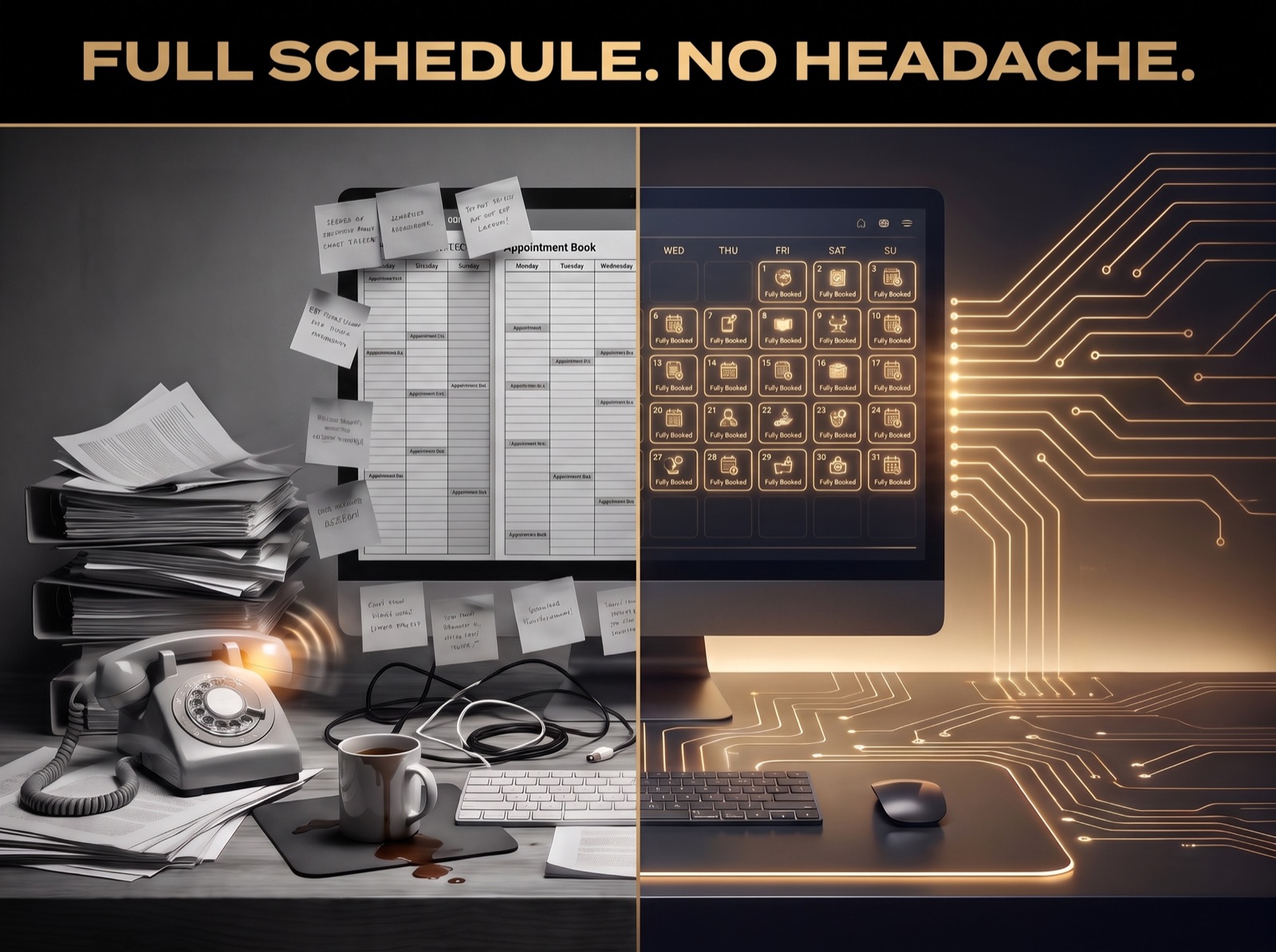
Most practices fill the schedule not by advertising harder, but by closing the gaps between a patient's interest and a booked appointment: the call that came in during a procedure, the form submitted at nine at night, the recall nobody sent. Automate those handoffs and the calendar tightens on its own.
A few empty slots a week doesn't feel like an emergency. It feels like a slow afternoon. But across a month, those gaps and last-minute cancellations quietly cost more than almost anything else in the practice — and nobody on the team has time to chase them down. The front desk is running the office, not running marketing.
Most practices don't have an awareness problem. They have a consistency problem: the marketing that fills the schedule only happens when someone remembers, and someone rarely remembers. Here's how to make it happen on its own.
The two problems underneath an empty schedule
First, the right patients don't know you exist yet. When someone searches for a specific service — an implant, a consultation, a specialist near them — they're high-intent and ready to book. If you're not visible and easy to choose at that moment, they pick whoever was.
Second, the patients you do attract leak out. An inquiry comes in and waits a day for a callback. A patient who's due for a recall never gets reminded. A no-show is never re-booked. None of that is anyone's fault — it's what happens when a busy team has to do follow-up by hand.
The second problem is usually the bigger one, and the cheaper one to fix. Spending more on ads to feed a leaky intake process just makes the leak expensive. Seal the leak first and every dollar after it works harder.
What does the gap between interest and booking actually look like?
It looks like a handful of ordinary moments in a normal week, none of which feel like a crisis on their own. That's exactly why they persist.
Someone calls while your only front-desk person is walking a patient through paperwork. It rings out. Nobody calls back until tomorrow afternoon, and by then the caller has booked down the road.
Someone fills out the contact form at 9 p.m. after their kids are asleep — which is when people actually research healthcare. It lands in an inbox nobody opens until 8:30 the next morning, and the message has cooled.
Someone cancels a Thursday appointment on Wednesday afternoon. That slot is worth real money, and there are patients who'd happily take it. But filling it means working a phone list for an hour, and nobody has that hour.
Someone finished treatment and is due back in six months. Six months arrives. Nothing happens. They aren't unhappy — they're just not reminded, and life is loud.
None of those are marketing failures in the way people usually mean it. They're handoff failures — moments where interest existed and the practice wasn't standing there to catch it. That's why the fix is an autonomous marketing system rather than a campaign. A campaign ends, and the gaps come right back.
What an automated practice marketing system handles
The fix isn't more hustle from the front desk. It's a system that does the repetitive work reliably and keeps a human in the loop for anything that touches a patient.
- Targeted acquisition. Campaigns aimed at the specific, high-value services you want more of — not generic "we're a dentist" awareness — with intake built to turn a click into a booked appointment.
- Local visibility. A maintained Google Business Profile and local search presence so you show up when someone searches your service nearby, plus getting recommended by AI assistants when patients ask who to see.
- Reminders and recall that run themselves. Automated appointment reminders and recall sequences that keep the schedule full and quietly reduce the gaps, without the desk making calls.
- Reviews on autopilot. A well-timed, automated nudge after good visits so your reputation online finally reflects the care you actually give.
Those four pieces work as one loop, not four projects. Visibility brings people to the door. Intake catches them the moment they knock. Reminders and recall keep existing patients coming back. Reviews make the next stranger more likely to choose you. Skip a piece and the loop leaks somewhere. How we build each piece for medical, dental, and specialty offices varies by practice; the shape of the loop doesn't.
What does the system look like step by step?
Here is the actual sequence, from a stranger's first click to a patient sitting in your chair again a year later.
- Intake. Every inbound path — phone, web form, chat, Google Business Profile message, ad click — lands in one place instead of four. Nothing lives only in someone's voicemail or personal inbox.
- Response. A new inquiry gets an immediate, plain acknowledgment that a real person is picking this up, followed by a fast human reply during hours. Speed matters more than polish here. A patient who hears back in minutes rarely keeps shopping.
- Booking. The response points to one obvious next step — a specific time, a link, a callback window — rather than "let us know what works." Fewer choices, fewer dropped threads.
- Confirmation and reminders. Once booked, the appointment gets confirmation and reminders on a set cadence, with an easy way to reschedule. Making rescheduling easy sounds like it costs you the slot; in practice it converts a silent no-show into a moved appointment you can refill.
- Post-visit follow-up. After a good visit, a well-timed request goes out so satisfied patients actually leave the review they'd have been happy to leave anyway. That's the whole idea behind turning patients into reviews automatically.
- Recall. Patients due for a return visit get reached on schedule — not when someone finally has a free afternoon to work the list. This is the single most-skipped step in most practices and often the fastest one to pay for itself.
- Gap filling. Cancellations trigger outreach to patients who wanted an earlier slot, so a hole in Thursday doesn't stay a hole.
Every one of those steps is something a well-run front desk would do if it had unlimited time. The system isn't smarter than your team. It just never gets pulled away mid-task.
Is it cheaper to just hire another front-desk person?
Sometimes, and it's a fair question to ask before spending anything on marketing. But the two options solve different problems, and it helps to see them side by side.
| | Doing it by hand | Running a system | |---|---|---| | After-hours inquiries | Wait until morning | Acknowledged immediately, human reply first thing | | Recall outreach | Happens when someone has a spare hour | Runs on schedule, every week | | Cancellation backfill | Manual phone list, often skipped | Automatic outreach to a waitlist | | Review requests | Asked when someone remembers | Sent after every eligible visit | | Consistency | Varies with staffing and busy days | Same on your busiest day as your slowest | | Scales by | Adding headcount | Adding services or locations | | Your team's role | Doing the follow-up | Approving and handling exceptions |
A second person at the desk gives you more hands during business hours. A system gives you coverage outside them and consistency inside them. Most practices need some of both — the system just means the person you hire spends their day on patients in front of them instead of a call list. To weigh it against a salary, our pricing is published.
Compliant by design
Healthcare marketing has rules, and "automated" can't mean "careless." A system built for practices keeps everything patient-facing under human approval and avoids anything that touches protected information in the wrong place. The machine drafts and schedules; your team signs off. You get the consistency of software without handing patient trust to a black box.
That balance — always-on marketing, always human-approved — is the whole point. The repetitive work happens every day; the judgment stays with you.
In practice that means a few working habits. Keep marketing messages generic about clinical detail; a reminder can say you have an appointment, not why. Keep patient records where they belong rather than copying lists into whatever tool is convenient. Keep an audit trail of what went out and who approved it. And run the whole setup past your compliance lead or counsel before it goes live — every practice has its own agreements, vendors, and obligations, and that review is theirs to make, not ours or a software vendor's.
The right posture is conservative. If a step in a workflow makes you uneasy about patient privacy, that's a signal to simplify the step, not to find a workaround.
What this does not fix
An automated system closes the gap between interest and booking. It cannot close gaps it isn't responsible for, and it's worth being blunt about which ones those are.
No capacity. If providers are already booked out and the constraint is chair time or clinical hours, more inbound patients create a waitlist, not revenue. That's a different project: scheduling, staffing, hours, or space.
A broken front-desk experience. If patients who do get through are met with a rushed tone, confusing pricing conversations, or a long wait before anyone acknowledges them, automation just delivers more people into that experience. Fix the room first. Software amplifies what's already there — good or bad.
Clinical reputation problems. If reviews are poor because the care experience has a real issue, prompting more reviews accelerates the truth rather than hiding it. That deserves a practice-level fix.
Wrong service mix. If you're attracting patients for procedures you don't want more of, the answer is sharper targeting, not more volume. More of the wrong patients is worse than fewer of the right ones.
The practices this works best for are the ones with room on the schedule, a team that treats people well, and no reliable way to keep the pipeline consistent. That's most of the practices and other local businesses we serve.
Where to start
Start here: fully complete your Google Business Profile, choose the one service you'd most like more of, and set up a simple automated reminder for upcoming appointments. Those three moves tend to tighten the schedule before you scale anything.
The profile matters more than most owners expect — for local practices it's often the cheapest lead source available, and it's free to fix. Hours, services, insurance details, photos, and a habit of responding to reviews will do more in a week than a new ad budget.
After that, pick the single leakiest handoff you have and close it — usually after-hours inquiries or recall. Don't build all seven steps at once. One reliable step beats five half-built ones.
Frequently Asked Questions
How fast will we see the schedule fill?
It depends on which gap you close first. Reminders and recall touch patients who already know you, so those tend to move the calendar soonest. New-patient acquisition through search and local visibility builds more gradually, because it depends on being found repeatedly rather than once. Plan on steady improvement rather than a spike.
Will patients find automated messages impersonal?
Not if the messages sound like your practice and arrive at sensible times. Patients dislike being forgotten far more than they dislike a well-written reminder. The tone problem comes from generic, over-frequent, salesy messaging — which is a writing and cadence decision you control, not something inherent to automation.
Do we have to replace our practice management software?
No. The goal is to sit alongside what you already use, not to rip it out. How deeply things connect depends on what your system allows, and some practices run a lighter setup where scheduling stays entirely in-house while intake, reminders, and recall are handled outside it. Both work.
Who approves what goes out to patients?
Your team does. Content, campaigns, and patient-facing sequences are drafted and scheduled by the system and signed off by a human before they run. Anything with compliance implications should also be reviewed by your compliance lead or counsel, since the specifics vary by practice, state, and the agreements you already have in place.
Is this worth it for a small single-provider practice?
Often more so, because a small practice has the least slack at the front desk and feels every empty slot. The scope is smaller — usually visibility, reminders, and recall before anything else. Start with the one or two steps that leak the most and expand only when those are running without you thinking about them.
Filling the schedule is mostly a plumbing problem, not a creativity problem. The patients are already interested; they just fall through the handoffs on a busy Tuesday. Close those gaps reliably and the calendar looks different.
If you'd rather have the whole system built and run for you — acquisition, reminders, recall, and reviews, all compliant and human-approved — that's what we do at Amagna. Chart your free Gold Map and we'll hand you a plan for filling your schedule with the right patients.
Want this for your business?
The Gold Map builds you a specific, step-by-step plan — free.
Get your Gold Map